

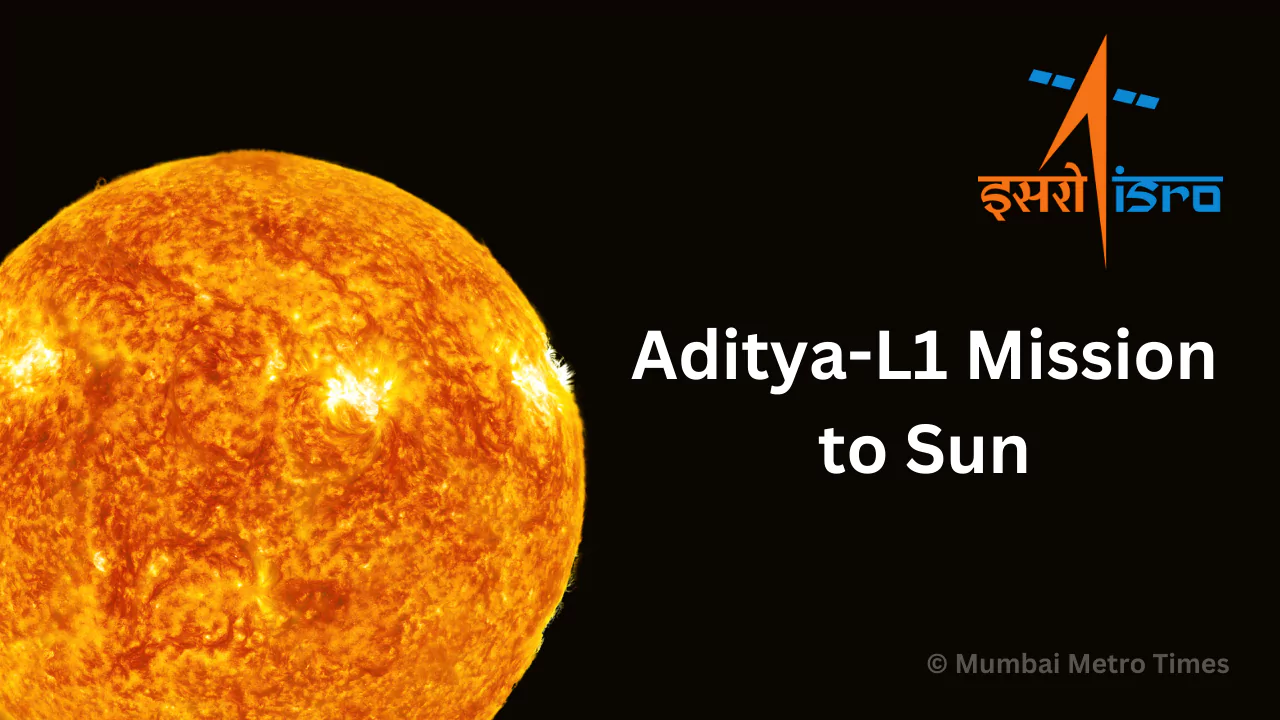
Just a day after Chandrayaan-3’s successful landing on the Moon, the Indian Space Research Organisation (Isro) declared its next exciting mission – Aditya-L1, solely focused on studying the Sun. Let’s delve into the details of this upcoming mission, scheduled for launch on September 2.
Aditya-L1: Journey to the Sun
Nilesh M Desai, the Director of Space Applications Centre-Isro in Ahmedabad, shared that the Aditya-L1 mission is fully prepared and eagerly awaiting its launch on September 2. This mission will use Isro’s PSLV rocket from the Satish Dhawan Space Centre SHAR (SDSC SHAR) in Sriharikota. The Aditya-L1 spacecraft is bound for a voyage approximately 15 lakh kilometers away from Earth, which is expected to take around 127 days.
Aditya-L1 will be positioned in a highly elliptical orbit, enabling it to closely and continuously observe the Sun. The mission’s primary goals include monitoring solar activity and enhancing our understanding of this crucial celestial body that sustains life on Earth.
The Aditya-L1 Mission: A Look
The Aditya-L1 mission showcases India’s ambitious attempt to explore the Sun, a celestial object that has fascinated scientists and space enthusiasts for centuries.
Tools of Discovery
The spacecraft will be equipped with a Visible Emission Line Coronagraph (VELC) to capture images and analyze the Sun’s light, aiming to uncover the secrets of the star’s science.
In addition to VELC, Aditya-L1 carries six more instruments dedicated to studying the Sun. Four of these instruments will directly observe the Sun from a unique spot called L1, while the other three will conduct on-the-spot investigations of particles and fields at the Lagrange point L1.
L1: The Perfect Observation Point
The Lagrange point L1 within the Earth-Sun system provides an unobstructed view of the Sun and currently hosts NASA’s Solar and Heliospheric Observatory Satellite SOHO. This strategic location allows for continuous monitoring of solar activities, making Aditya-L1 India’s first-ever mission to study the Sun.
Aditya-L1’s seven payloads will scrutinize different layers of the Sun, including the photosphere, chromosphere, and the outermost layer, known as the corona. This will be done using special tools like electromagnetic and particle detectors, providing valuable insights into solar dynamics in the space between planets.
Key Insights
The information gathered by Aditya-L1’s payloads is anticipated to provide crucial details for understanding processes like coronal heating, coronal mass ejections, flare activities, space weather patterns, and how particles and fields travel, among other phenomena.
A Sun-Focused Future
Aditya-L1’s mission is clear: to uncover the secrets of our life-giving Sun. With its advanced instruments and cutting-edge technology, we’re about to learn more about the star that makes life on Earth possible.