

- OpenAll 7 days of the week
- Best timeEarly morning for photos · after 7 PM for the lights
- Built1878 – 1888 · architect F. W. Stevens
- StatusUNESCO World Heritage Site since 2004
- Nearest metroCSMT next to the stationLine 3 · Aqua
- Local trainsCSMT terminus of two linesCentralHarbour
- AddressDr Dadabhai Naoroji Road, Fort, Mumbai 400001
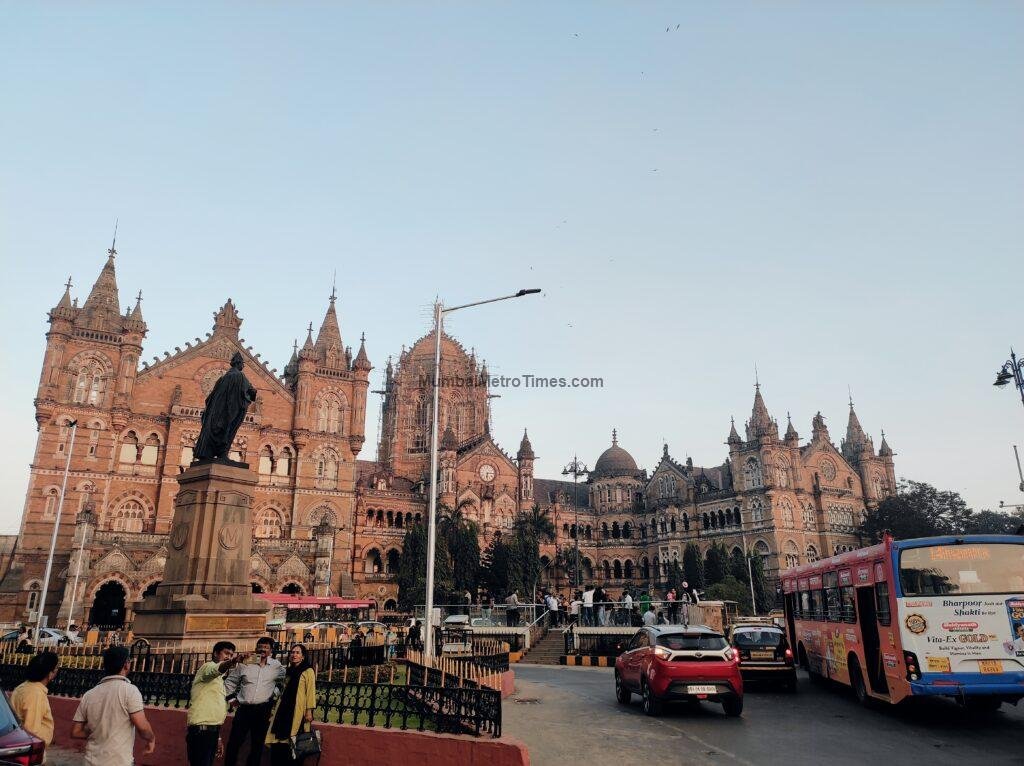
Chhatrapati Shivaji Maharaj Terminus (CSMT), formerly Victoria Terminus, is Mumbai’s grandest building and one of the busiest railway stations in India. Completed in 1888 and designed by Frederick William Stevens, this Victorian Gothic masterpiece is a UNESCO World Heritage Site, the headquarters of Central Railway, and the end of the line for every Central and Harbour local train. This page covers its history and architecture, what you can see inside, the best time to visit and photograph it, how to reach it by metro, local train or road, and places, food and hotels nearby.
- About
- History
- Architecture
- Inside the station
- Timings & best time
- How to reach
- Photos
- Heritage walk
- Nearby places
- Food nearby
- Hotels
- Tips
- FAQs
About CSMT
CSMT stands on Dr Dadabhai Naoroji Road in the Fort area of south Mumbai, facing the busy junction opposite the Municipal Corporation headquarters. The main heritage building, with its great central dome, pointed arches, towers and carved stonework, houses the offices of Central Railway. Behind and beside it are the train sheds and platforms, used by millions of passengers every day.
It is a rare monument that is also fully in use. Commuters rush through the halls on their way to work, long-distance travellers arrive from across India, and tourists stand on the pavements across the road to photograph the facade. Most Mumbaikars still call the station by its old initials, “VT”, or by “CST”.
For visitors, CSMT is both a sight in its own right and a natural starting point for exploring south Mumbai. Within a short walk you can reach the BMC building, Flora Fountain, Kala Ghoda, Crawford Market and, a little further, the Gateway of India.
CSMT history
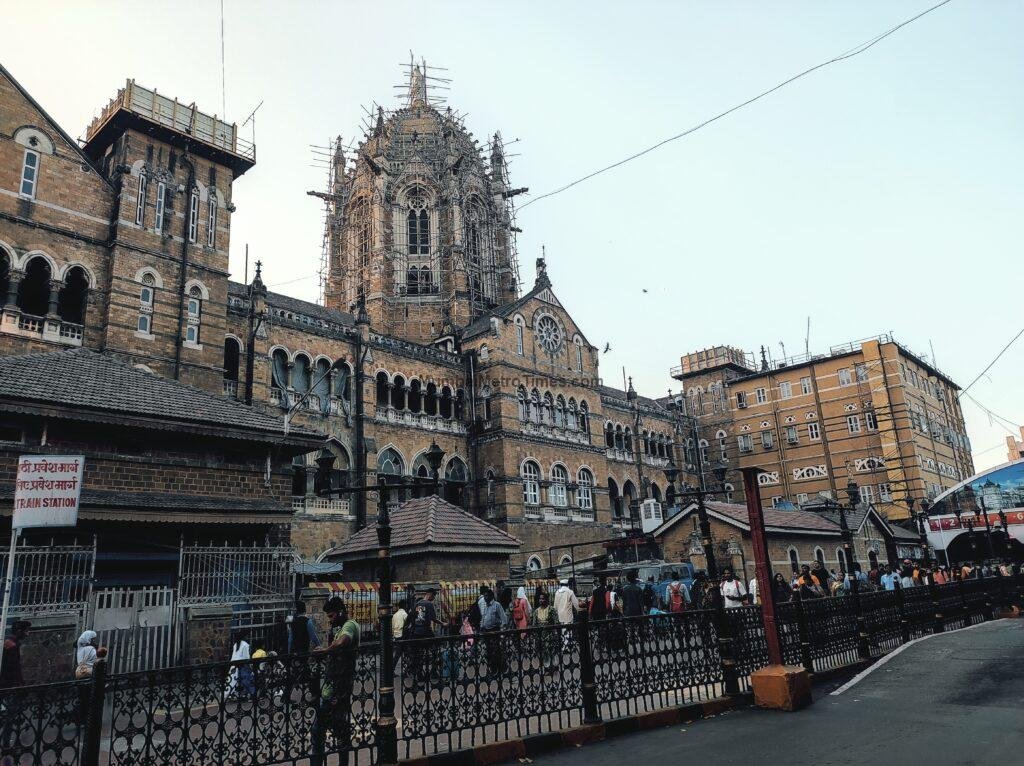
Railways in India began on this very site. On 16 April 1853 the first passenger train in the country left a modest station at Bori Bunder for Thane, 34 km away. As Bombay grew into the main port and trading city of British India, the Great Indian Peninsula Railway needed a headquarters and terminus to match its importance.
Work on the new building started in 1878 to the designs of Frederick William Stevens, an English architect working for the railway, who developed an earlier watercolour design by the artist Axel Haig. It took about ten years to build, longer than any other building in the city at the time. It was named Victoria Terminus to mark Queen Victoria’s Golden Jubilee in 1887, and was completed in 1888.
- 1853The first train
On 16 April 1853, India’s first passenger train runs 34 km from Bori Bunder, on this site, to Thane.
- 1878Construction begins
The Great Indian Peninsula Railway starts building a grand new headquarters and terminus, designed by Frederick William Stevens.
- 1887Victoria Terminus
The station is named Victoria Terminus to mark Queen Victoria’s Golden Jubilee. The building is completed in 1888, after about ten years of work.
- 1996A new name
The station is renamed Chhatrapati Shivaji Terminus, after the 17th-century founder of the Maratha empire.
- 2004UNESCO World Heritage
CSMT becomes a UNESCO World Heritage Site as an outstanding example of Victorian Gothic Revival architecture in India.
- 200826/11 attack
On 26 November 2008, terrorists attack the station’s passenger hall, killing 58 people. A memorial inside remembers the victims.
- 2017CSMT
The word “Maharaj” is added, giving today’s name: Chhatrapati Shivaji Maharaj Terminus.
- TodayRedevelopment
A major redevelopment is under way to modernise the station around the heritage building, with completion targeted for 2027–28.
In 1996 the station was renamed Chhatrapati Shivaji Terminus in honour of the 17th-century Maratha ruler, and in 2017 the word “Maharaj” was added. The station has also seen tragedy: during the attacks of 26 November 2008, gunmen opened fire in the main passenger hall. A memorial in the station honours those who lost their lives.
CSMT is now in the middle of a major redevelopment. The project, costing about ₹2,450 crore, will add new concourses, elevated decks and better passenger facilities around the heritage building, which is being preserved. Work began in stages and is targeted for completion around 2027–28, so expect some construction areas and diversions when you visit.
CSMT architecture
CSMT is regarded as one of the finest examples of Victorian Gothic Revival architecture anywhere in the world. Stevens combined the pointed arches, towers and stained glass of the Gothic style with domes, turrets and decorative details drawn from Indian palace architecture. The result is a building that could only be in Mumbai. Look out for these features:
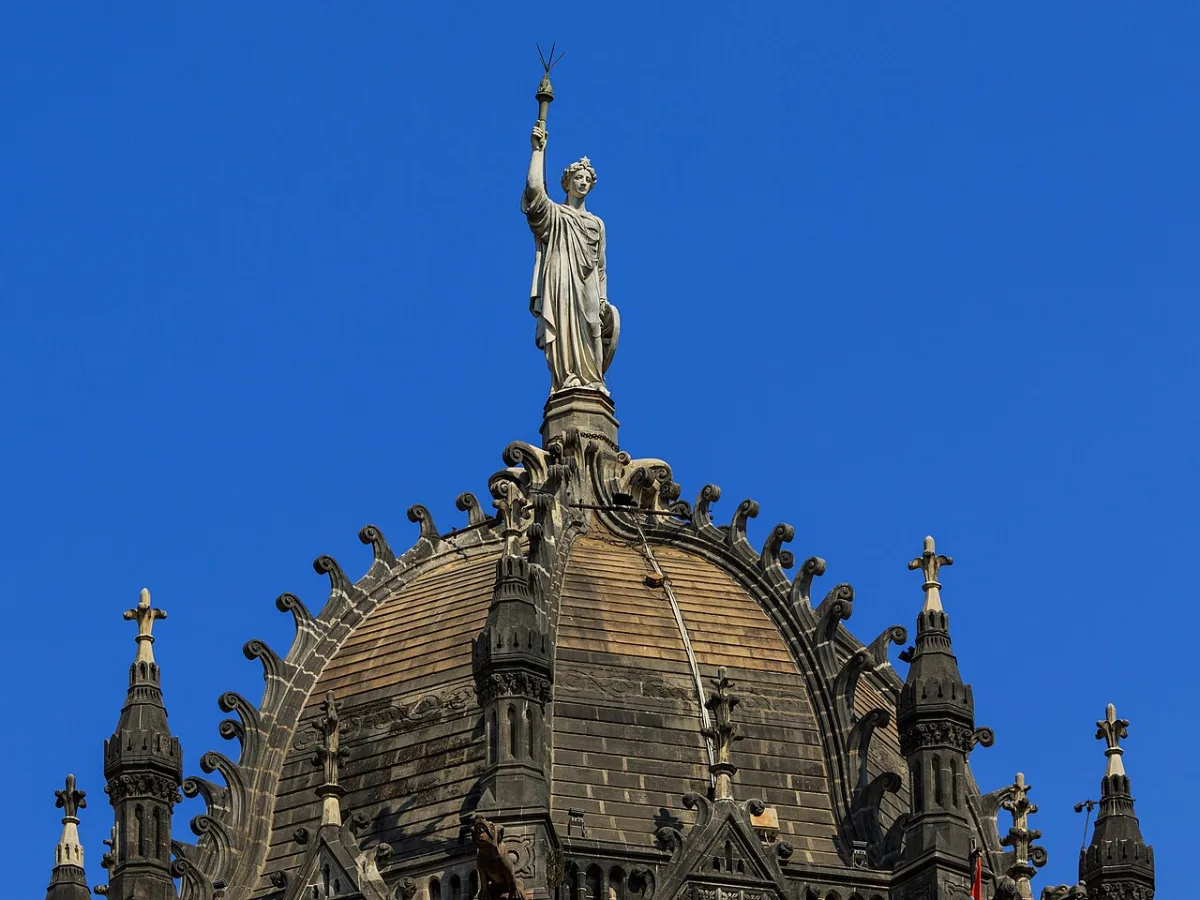
- The central dome – a large octagonal ribbed dome, one of the first of its kind on a Gothic building, crowned by a statue of Progress holding a torch and a spoked wheel.
- The C-shaped plan – the building wraps around a forecourt facing the junction, with wings on both sides.
- Lion and tiger statues on the gate pillars, representing Britain and India.
- Carved stone details – gargoyles, peacocks, monkeys, foliage and portrait medallions, carved by students of the Sir J. J. School of Art.
- Materials – yellow sandstone and limestone outside, with Italian marble, polished Indian stone and stained glass inside.
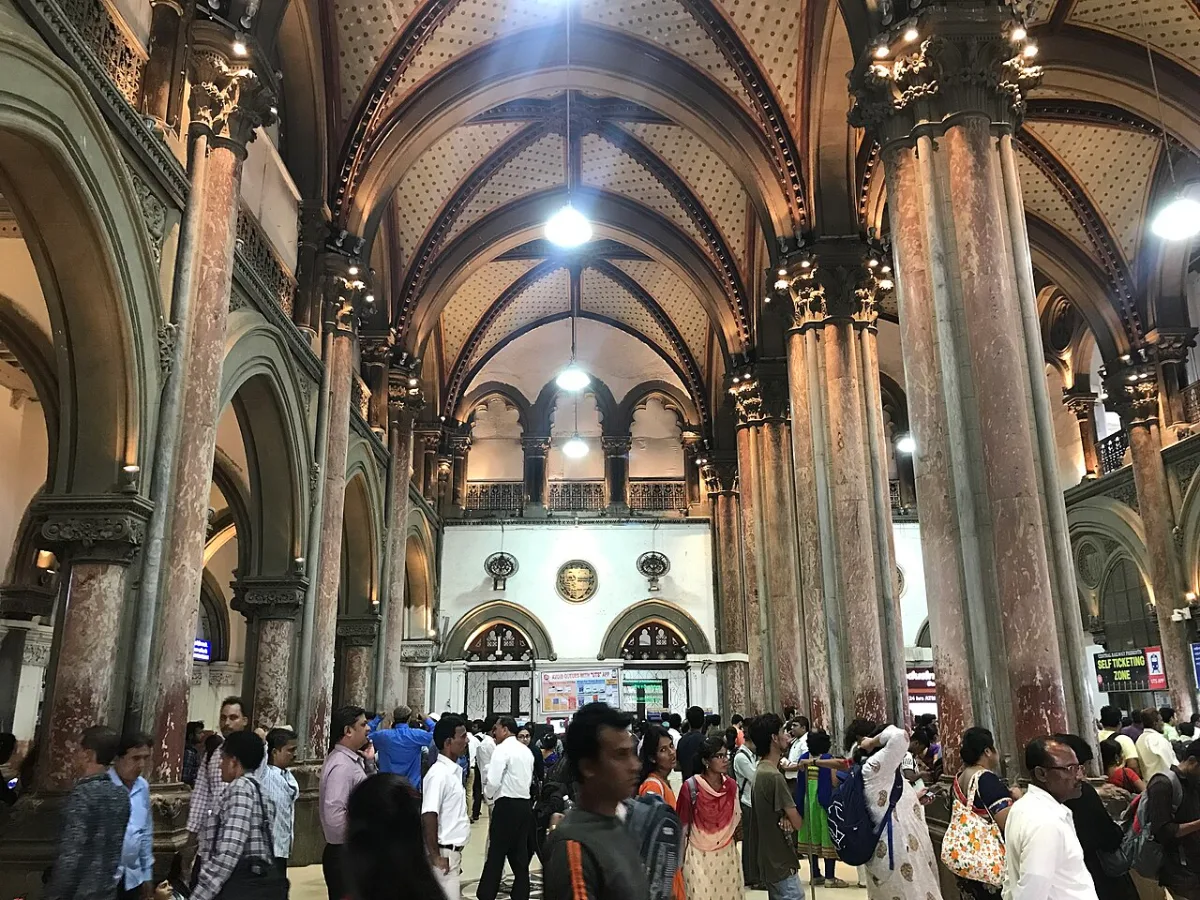
- The booking hall – a high, vaulted space with ribbed ceilings and Gothic arches, still used every day.
In 2004 UNESCO added CSMT to its list of World Heritage Sites, describing it as an outstanding example of the meeting of Italian Gothic Revival and Indian traditional architecture, and as a symbol of Bombay as a great commercial port.
Inside the station
Anyone can walk into the concourse and the old booking hall to see the vaulted ceilings, arches and stained glass, which are still in daily use. To go onto the platforms without a train ticket, buy a platform ticket from a counter or ticket machine.
The main heritage building also contains the headquarters of Central Railway and a heritage museum with railway artefacts and the story of the station. These areas are not freely open, but they can be seen on guided heritage tours. Central Railway and private walking-tour companies run tours on selected days, typically lasting 60–90 minutes and including the grand staircase under the dome. Tour days, timings and fees change, so check and book before you go, and carry a photo ID.
Timings, entry fee and best time to visit
| Detail | Information |
|---|---|
| Timings | Station open 24 hours, all 7 days |
| Entry fee | Free to see the building and concourse |
| Platform ticket | Required to go onto the platforms without a train ticket |
| Heritage tour | Selected days only · paid · book in advance |
| Time needed | 30 – 45 minutes · 1.5 hours with a heritage tour |
| Best time | Before 8 AM for photos · after 7 PM for the lit-up facade |
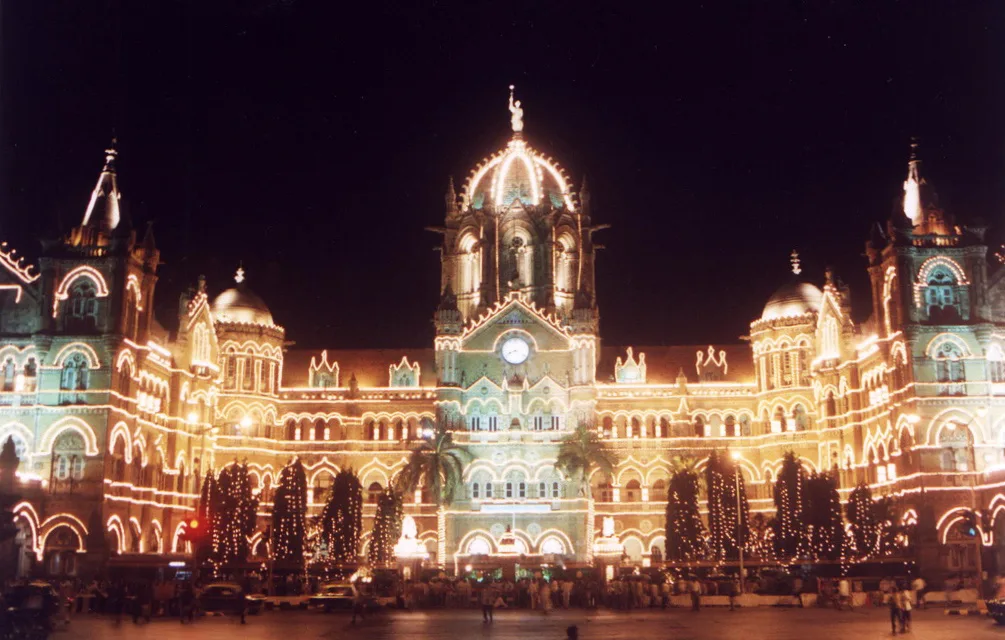
The station is busiest during the morning rush, roughly 8 to 11 AM, and the evening rush, roughly 5 to 9 PM, when crowds can be overwhelming. Sundays and holidays are much calmer. In the evening the facade is lit up, sometimes in special colours on national days and festivals, and it is a spectacular sight from across the road.
The most popular photo spot is the traffic island and pavement at the junction in front of the station, near the BMC building, which gives a full view of the facade and dome. Photography of the outside is unrestricted. Inside, take personal photos considerately; tripods and professional shoots need permission from Central Railway.
How to reach CSMT
CSMT is one of the best-connected places in the city: it is a terminus for two local train lines and long-distance trains, and it has its own Metro Line 3 station.
- 1Take Metro Line 3 (Aqua Line) to CSMT station
- 2Follow the signs for the CSMT railway station exit
- 3You come up a short walk from the heritage building
Line 3 runs from the airport, BKC, Dadar and Worli with no change of train.
- 1Take any Central line or Harbour line train heading south
- 2Every train ends at CSMT, so you cannot miss your stop
- 3From the Western line, change at Dadar, or get off at Churchgate and walk 20 minutes
See the Mumbai local train page and the local train map.
- 1Many BEST buses stop at CSMT on Dr D. N. Road; check the Chalo app
- 2Taxis and app cabs can drop you at the main building or the suburban entrance
- 3Traffic around CSMT is heavy at peak hours; allow extra time
Long-distance trains also start and end here, so it is a convenient first stop in Mumbai.
From Mumbai airport
- 1Take Metro Line 3 from the airport terminal station
- 2Ride straight through to CSMT (around 50 minutes)
- 3Walk a few minutes to the heritage building
The easiest and most predictable option, avoiding road traffic completely.
- 1Book a prepaid taxi or app cab at the terminal
- 2The road distance is roughly 25–30 km
- 3Allow 60–90 minutes depending on traffic
Late night and early morning are the quickest times to drive into south Mumbai.
Nearest metro stations to CSMT
All three are on Metro Line 3 (Aqua Line). Distances are approximate walking distances.
Nearest local train stations
CSMT is itself the terminus of the Central and Harbour lines.
Planning a longer trip? See the Mumbai Metro page for every line, fare and timing, and the Mumbai Metro map for routes across the city.
CSMT photos
Our own photos, plus night, dome and interior views from Wikimedia Commons.


Heritage walk from CSMT to the Gateway of India
CSMT is the perfect start for a walk through south Mumbai’s heritage district. The route is about 2.3 km and takes around an hour at an easy pace.
- 0 kmCSMT
Start at the main heritage building and look up at the dome and the statue of Progress.
- 0.1 kmBMC headquarters
Directly opposite: the Municipal Corporation building, also designed by F. W. Stevens and completed in 1893.
- 0.4 kmAzad Maidan
The large open ground beside the station, where you can often watch cricket matches.
- 1.0 kmFlora Fountain
Walk down D. N. Road, past grand Victorian buildings, to Hutatma Chowk and the Flora Fountain.
- 1.6 kmKala Ghoda
The art district, with galleries, cafés and the Jehangir Art Gallery.
- 2.3 kmGateway of India
Finish by the sea at the Gateway of India and the Taj Mahal Palace.
Places to visit near CSMT
- BMC headquarters (opposite) – the Municipal Corporation building, another Gothic landmark by F. W. Stevens, beautifully lit at night.
- Crawford Market (Mahatma Jyotiba Phule Mandai, about 1 km) – a historic covered market for fruit, spices and household goods.
- Flora Fountain and Hutatma Chowk (about 1 km) – the heart of the Fort area.
- Kala Ghoda and the Jehangir Art Gallery (about 1.6 km) – galleries, cafés and the annual Kala Ghoda Arts Festival in February.
- Chhatrapati Shivaji Maharaj Vastu Sangrahalaya (about 2 km) – Mumbai’s main museum of art, history and natural history.
- Gateway of India (about 2.3 km) – the city’s best-known monument, with boats to Elephanta.
- Wankhede Stadium (about 2 km) – Mumbai’s international cricket ground near Churchgate.
- Marine Drive (about 2.5 km) – the curving seafront known as the Queen’s Necklace, best at sunset.
Where to eat near CSMT
- Kyani & Co. – one of Mumbai’s oldest Irani cafés, near Metro Cinema, for bun maska, chai and keema pav.
- Badshah Cold Drinks – at Crawford Market, famous for falooda and fruit juices.
- Ram Krishna – a simple South Indian vegetarian restaurant in Fort, good for a quick, affordable meal.
- Café Excelsior – a classic Irani-style café in Fort for snacks and Indian-Chinese food.
- Station food stalls – vada pav, sandwiches and tea inside and around the station for a quick bite.
Hotels near CSMT
- Hotel City Palace – a budget hotel directly opposite the station.
- The Residency Hotel, Fort – a mid-range hotel a few minutes’ walk away.
- Grand Hotel, Ballard Estate – a heritage-style hotel in the quiet Ballard Estate business district.
- Taj Mahal Palace – luxury at the Gateway of India, about 2.3 km away.
- Trident, Nariman Point – sea-facing luxury about 3 km away.
Tips for visiting CSMT
- Avoid the rush hours, roughly 8 to 11 AM and 5 to 9 PM, especially on weekdays.
- Use the pedestrian subway or signals to cross the junction; the traffic in front of the station is heavy.
- Keep your phone and wallet secure in crowded halls and on platforms.
- For the best photos, visit early on a Sunday morning, then come back after dark to see the lights.
- Book a guided heritage tour in advance if you want to see the dome staircase and the heritage museum.
- Combine your visit with the heritage walk through Fort to the Gateway of India.
Frequently asked questions
What is the full form of CSMT?
CSMT stands for Chhatrapati Shivaji Maharaj Terminus. The station was called Victoria Terminus (VT) until 1996, then Chhatrapati Shivaji Terminus (CST), and has had its current name since 2017. Many people still call it VT or CST.
Who designed Chhatrapati Shivaji Maharaj Terminus?
It was designed by Frederick William Stevens, an English architect working for the Great Indian Peninsula Railway. Construction took about ten years, from 1878 to 1888.
Is there an entry fee to visit CSMT?
No. The station concourse is open to everyone, 24 hours a day. To go onto the platforms without a train ticket you need a platform ticket, available at the ticket counters and machines. Guided heritage tours of the building are charged separately.
Can you go inside the CSMT heritage building?
The booking hall and concourse are open to all. The heritage building also houses the Central Railway headquarters and a heritage museum, which can be seen on guided heritage tours. Check the current tour days and timings before you go.
Which is the nearest metro station to CSMT?
CSMT station on Metro Line 3 (Aqua Line) is right next to the railway terminus. Hutatma Chowk on the same line is about 900 metres away, near Flora Fountain.
Why is CSMT a UNESCO World Heritage Site?
UNESCO listed CSMT in 2004 as an outstanding example of Victorian Gothic Revival architecture in India, blended with themes from traditional Indian architecture, and as a symbol of Mumbai as a major trading port.
How many platforms does CSMT have?
CSMT has 18 platforms. Platforms 1 to 7 are for suburban local trains on the Central and Harbour lines, and platforms 8 to 18 are for long-distance trains.
What is the statue on top of the CSMT dome?
The statue on the dome is a female figure representing Progress, holding a torch in one hand and a spoked wheel in the other. It is often mistaken for Queen Victoria.
What is the best time to photograph CSMT?
Early morning, before about 8 AM, when traffic and crowds are light, and in the evening after about 7 PM, when the facade is lit up. The traffic island at the junction in front of the station gives the classic full view.
Exploring south Mumbai? See our Mumbai Metro page and the Mumbai Metro map for the easiest routes to CSMT.
