



- OpenAll 7 days of the week
- Best timeOctober – March · early morning or after 5 PM
- Built1915 – 1924 · opened 4 December 1924
- Nearest metroHutatma Chowk ~1.5 km · 18–20 min walkLine 3 · Aqua
- Nearest local train
- Boats from hereElephanta CavesAlibaug (Mandwa)Harbour rides
- AddressApollo Bandar, Colaba, Mumbai, Maharashtra 400001
The Gateway of India is Mumbai’s best-known landmark: a 26-metre basalt arch on the waterfront at Apollo Bandar in Colaba, looking out over Mumbai Harbour and the Arabian Sea. Built to mark a royal visit in 1911 and completed in 1924, it is today a free, open-all-day public space, the starting point for ferries to Elephanta Caves and Alibaug, and the first stop for almost every visitor to the city. This page covers its history and architecture, timings, how to reach it by metro, local train or road, boat rides, the best things to see nearby, and practical tips for your visit.
- About
- History
- Architecture
- Timings & best time
- How to reach
- Boat rides
- Photos
- Nearby places
- Food nearby
- Hotels
- Tips
- FAQs
About the Gateway of India
The Gateway stands at the tip of the Apollo Bandar promenade, directly opposite the Taj Mahal Palace hotel, in the heart of south Mumbai’s heritage district. A large paved plaza surrounds it, with a sea wall on one side and the jetties for passenger boats on the other. Facing the arch from the land side is an equestrian statue of Chhatrapati Shivaji Maharaj, and nearby is a statue of Swami Vivekananda, who sailed from Bombay in 1893 on his journey to the Parliament of the World’s Religions in Chicago.
For more than a century the Gateway has been the city’s symbolic front door. In the days when most travellers reached India by sea, viceroys, governors and other dignitaries were received here. Today it plays a different role: families come for an evening walk, tourists for photographs, and thousands of people pass through every day on their way to the boats. On a weekend evening the plaza is full of balloon sellers, photographers, snack vendors and people simply watching the boats rock in the harbour.
It is not a museum and there is nothing to “go inside”: the experience is the monument itself, the sea views, and the surrounding area of Colaba, which is full of history, cafés and shopping. Most visitors spend 30 minutes to an hour at the Gateway, then combine it with a boat ride or with nearby sights such as Colaba Causeway, Kala Ghoda and the Chhatrapati Shivaji Maharaj Vastu Sangrahalaya museum.
Gateway of India history
In December 1911 King George V and Queen Mary became the first reigning British monarchs to visit India. They landed at Apollo Bunder on their way to the Delhi Durbar, where the shift of the capital from Calcutta to Delhi was announced. The government decided to mark the landing with a permanent monument, but it was not ready in time: the royal couple were welcomed by a temporary structure made of cardboard and plaster.
Building the real thing took more than a decade. The foundation stone was laid in 1913, but first the sea at Apollo Bunder had to be reclaimed and a new sea wall built. Construction ran from 1915 to 1924, and the monument cost about ₹21 lakh at the time, paid for by the Government of India. Because of the slow progress, the King and Queen never saw the finished Gateway.
- 1911The royal landing
King George V and Queen Mary land at Apollo Bunder on 2 December. They are greeted by a temporary cardboard and plaster arch, as the real monument does not exist yet.
- 1913Foundation stone
On 31 March, the Governor of Bombay, Sir George Sydenham Clarke, lays the foundation stone.
- 1914Design approved
Architect George Wittet’s final design is sanctioned. Land at Apollo Bunder is reclaimed from the sea before building can begin.
- 1915–1924Construction
The arch, its towers and the new sea wall are built over almost a decade.
- 1924Opening
On 4 December, the Viceroy, the Earl of Reading, formally opens the Gateway of India.
- 1948The British leave
On 28 February, the last British troops in India, the 1st Battalion of the Somerset Light Infantry, march out through the arch and board ships home.
- 1961Shivaji Maharaj statue
An equestrian statue of Chhatrapati Shivaji Maharaj is unveiled facing the Gateway, on Republic Day.
- TodayMumbai’s icon
A protected Grade I heritage structure, a ferry point for Elephanta and Alibaug, and the city’s most photographed landmark.
The Gateway is also tied to the end of British rule. On 28 February 1948, the last British troops in India marched through the arch to the ships waiting in the harbour, in a ceremony that marked the formal departure of the British Army. A monument built to celebrate the arrival of an emperor thus became the place where the empire left.

Since independence the Gateway has stayed at the centre of city life. It hosts official events such as the Indian Navy Day celebrations in December, New Year gatherings, cultural festivals and national day illuminations. It has also seen difficult moments, including a bomb blast nearby in August 2003, after which security around the plaza was tightened. The monument itself was not damaged. Today it is a protected Grade I heritage structure, and the state archaeology department monitors and repairs its stonework, which has been worn by more than a century of salt air.
Architecture and design
The Gateway was designed by George Wittet, a Scottish architect who also worked on the Prince of Wales Museum (now the Chhatrapati Shivaji Maharaj Vastu Sangrahalaya) nearby. His design is in the Indo-Saracenic style, which blends European forms with Indian and Islamic elements. The overall shape follows the tradition of the Roman triumphal arch, while the latticework, carved brackets and decorative details draw on sixteenth-century Gujarati architecture.
- Material: yellow basalt quarried locally, with a reinforced concrete core. The stone takes on a warm golden colour in the evening sun.
- Height: about 26 metres (85 feet) to the top of the towers.
- Central dome: about 15 metres in diameter, hidden behind the facade. Stand under the arch and look up to see it.
- Four turrets crown the structure, one at each corner, with intricate stone screens (jaalis) between them.
- Side halls: the arch is flanked by halls that were designed to seat around 600 people for receptions.
- Steps to the sea: behind the arch, steps lead down to the water, where boats once landed dignitaries.
What is written on the Gateway of India?
Above the central arch, an inscription records the reason the monument was built: “Erected to commemorate the landing in India of their Imperial Majesties King George V and Queen Mary on the Second of December MCMXI.” MCMXI is 1911 in Roman numerals.

Timings, entry fee and best time to visit
| Detail | Information |
|---|---|
| Timings | Open 24 hours, all 7 days |
| Entry fee | Free |
| Time needed | 30 – 60 minutes (longer with a boat ride) |
| Best season | October to March |
| Best time of day | 6 – 9 AM for quiet photos · 5 – 8 PM for sunset and lights |
| Photography | Allowed; drones are not permitted without police permission |
The Gateway is pleasant to visit in any season, but the cooler, drier months from October to March are the most comfortable. From June to September the monsoon brings dramatic waves that crash against the sea wall, which is a spectacular sight, but the promenade can be wet and windy and boat services are reduced or suspended. Stay well back from the edge on rough days and follow police instructions.
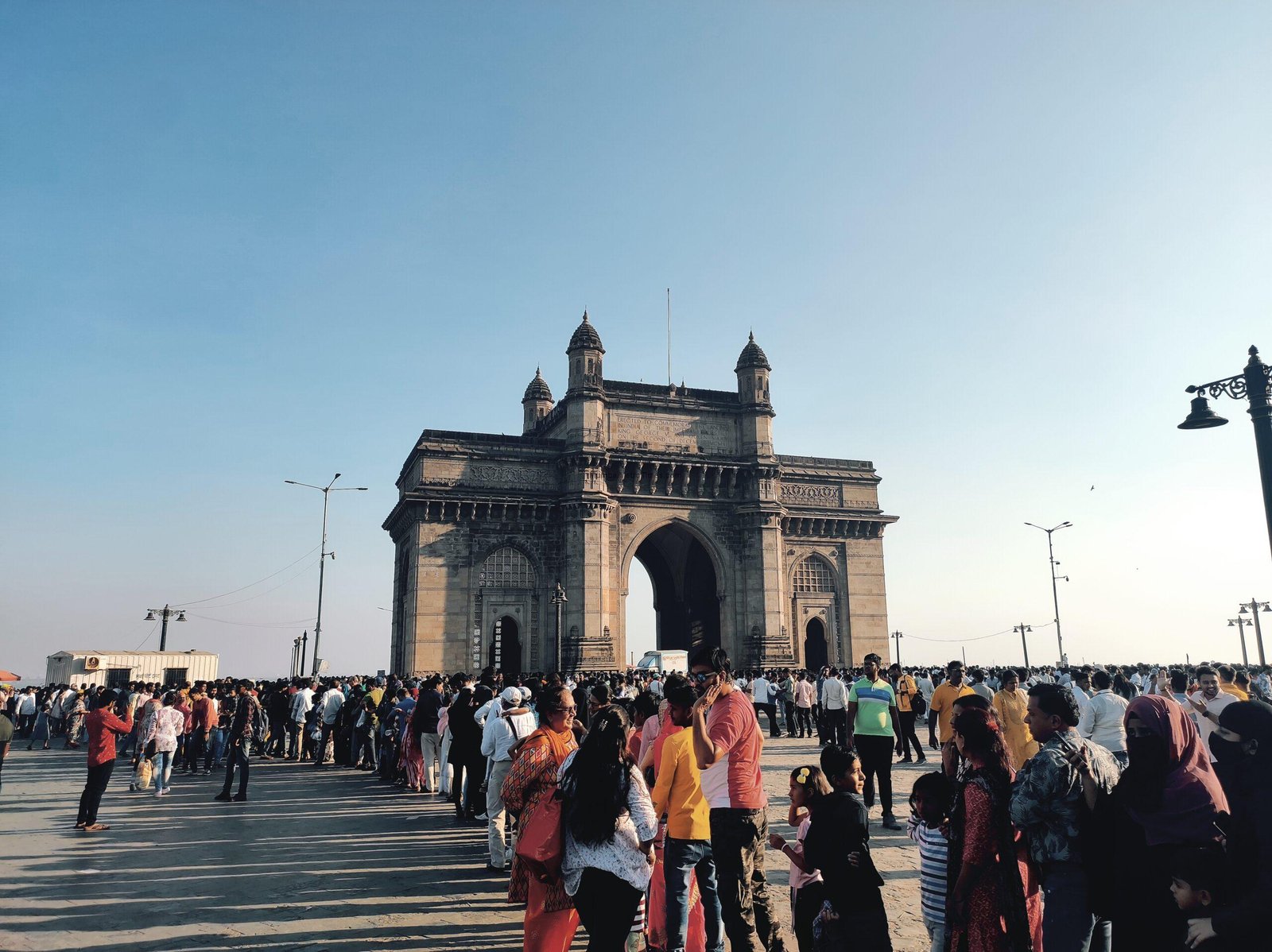
Early morning is the best time for photographs: the light is soft, the plaza is nearly empty and you can get a clean shot of the arch. Evenings are livelier, and after sunset the monument is lit up. On national holidays such as Independence Day and Republic Day, it is often illuminated in the colours of the national flag. Weekends and holiday evenings can be extremely crowded.
How to reach the Gateway of India
The Gateway is at the southern end of the city, so public transport is usually faster than driving. Metro Line 3 is the easiest option from most of the city, including the airport; local trains are the cheapest.
- 1Take Metro Line 3 (Aqua Line) to Hutatma Chowk
- 2Exit towards Flora Fountain and walk south via Kala Ghoda and Regal Circle
- 3Turn left after Regal Circle on to Chhatrapati Shivaji Maharaj Marg and walk to the waterfront
Line 3 runs from the airport, BKC, Dadar and Worli with no change of train.
- 1Take a Western line train to Churchgate, or a Central or Harbour line train to CSMT
- 2Walk about 25–30 min, or take a taxi or app cab (5–10 min)
- 3Ask for the Gateway of India or the Taj hotel at Apollo Bandar
Both are terminus stations, so every train stops there. See the Mumbai local train page.
- 1BEST buses towards Colaba, Electric House or Navy Nagar stop at Regal Circle or Electric House, a short walk away
- 2Taxis and app cabs drop you on Chhatrapati Shivaji Maharaj Marg next to the plaza
- 3Avoid driving: parking near the Gateway is very limited, especially on weekends
Check live bus routes and timings in the Chalo app.
From Mumbai airport
- 1Take Metro Line 3 from the CSMIA terminal station
- 2Ride to Hutatma Chowk (around 45–55 minutes)
- 3Walk 18–20 minutes or take a short taxi ride
Usually the fastest and most predictable option, especially at peak hours.
- 1Book a prepaid taxi or app cab at the terminal
- 2The road distance is roughly 25–30 km
- 3Allow 60–90 minutes depending on traffic
Late night and early morning are the quickest times to drive into south Mumbai.
Nearest metro stations to the Gateway of India
All four are on Metro Line 3 (Aqua Line). Distances are approximate walking distances.
Nearest local train stations
Local train stations within about 3.5 km of the Gateway.
Planning a longer trip by metro? See the Mumbai Metro page for every line, fare and timing, and the Mumbai Metro map for routes across the city.
Boat rides and ferries from the Gateway
The jetties beside the Gateway are one of the busiest passenger boat points in Mumbai. Ticket booths are on the promenade next to the jetties; buy only from the official counters and keep your ticket for the return trip.

| Boat service | Journey time | When it runs |
|---|---|---|
| Elephanta Caves ferry | About 1 hour each way | Roughly 9 AM to early afternoon; return boats until late afternoon. Caves closed on Mondays |
| Alibaug (Mandwa jetty) catamaran or launch | About 1 hour | Early morning to evening; reduced or suspended in the monsoon |
| Speedboat to Mandwa or Elephanta | 20 – 25 minutes | On demand, weather permitting |
| Short harbour ride | 30 – 45 minutes | Through the day; popular at sunset |
Fares change from time to time, so check the boards at the ticket counters. As a rough guide, ordinary launches cost a few hundred rupees per person, and speedboats cost two to three times more. Wear the life jacket you are given for the whole journey, do not crowd one side of the boat, and avoid boat trips in rough weather. Most services to Mandwa and Elephanta are cut back during the monsoon, roughly from June to August.
A new passenger jetty and terminal building is being built near the Radio Club in Colaba, a short distance from the Gateway, to take ferry traffic away from the crowded monument plaza. The project was cleared by the Supreme Court in 2025 and work is under way; once it opens, some or all ferries are expected to shift there. Check the departure point before you go.
Gateway of India photos
Photos taken by our team at the Gateway of India.


Places to visit near the Gateway of India
The Gateway sits in one of Mumbai’s richest heritage areas. These places are all within easy walking distance or a short taxi ride:
- The Taj Mahal Palace (opposite) – the landmark hotel opened in 1903, two decades before the Gateway. Its sea-facing facade is as photographed as the arch itself.
- Elephanta Caves (by boat, about 1 hour) – rock-cut cave temples from the 5th–7th centuries, a UNESCO World Heritage Site, with the famous three-headed Sadashiva sculpture.
- Colaba Causeway (about 500 m) – south Mumbai’s best-known street market for jewellery, clothes, bags and souvenirs, plus classic cafés.
- Chhatrapati Shivaji Maharaj Vastu Sangrahalaya (about 800 m) – the city’s main museum, in a grand Indo-Saracenic building also designed by George Wittet.
- Jehangir Art Gallery and Kala Ghoda (about 1 km) – the heart of Mumbai’s art district, with galleries, the Kala Ghoda Arts Festival every February, and heritage streets.
- Regal Circle and Wellington Fountain (about 600 m) – a historic roundabout with the Art Deco Regal Cinema.
- Chhatrapati Shivaji Maharaj Terminus (about 2.3 km) – the Victorian Gothic railway station, also a UNESCO World Heritage Site. Flora Fountain is on the way.
- Marine Drive (about 2.5 km) – the curving seafront promenade known as the Queen’s Necklace, best at sunset.
- Sassoon Dock (about 2 km) – one of Mumbai’s oldest docks and a busy fish market in the early morning.
- Alibaug (by boat, about 1 hour) – a coastal town with beaches and forts, popular for a day trip.

Where to eat near the Gateway of India
Colaba has something for every budget, from street food to fine dining:
- Bademiya – a famous late-night kebab and roll counter in the lane behind the Taj. Busy and basic, but loved by locals.
- Leopold Café and Café Mondegar – classic Colaba Causeway cafés, open since the 19th and 20th centuries, good for a beer, a snack and people-watching.
- Olympia Coffee House – an old Irani-style café for keema pav and chai.
- Sea Lounge at the Taj Mahal Palace – the classic spot for high tea with a view of the Gateway and the harbour.
- The Table – a well-known modern restaurant on Apollo Bunder road, a few minutes’ walk away.
- Street snacks on the promenade – roasted peanuts, bhel and corn are sold around the plaza; choose busy, clean stalls.
Hotels near the Gateway of India
Staying in Colaba lets you see the Gateway at sunrise, before the crowds arrive. Options range from heritage luxury to budget guest houses:
- The Taj Mahal Palace and Taj Mahal Tower – luxury, directly opposite the Gateway, with harbour-view rooms.
- Abode Bombay – a stylish boutique hotel on Colaba Causeway.
- Hotel Suba Palace – a mid-range hotel in a quiet lane a short walk away.
- YWCA International Guest House – a long-running, good-value guest house on Madame Cama Road.
- Backpacker Cowies – a popular budget hostel in Colaba.
- The Oberoi, Nariman Point – luxury on Marine Drive, about 10 minutes away by car.
Tips for visiting the Gateway of India
- Go early in the morning for photos without crowds, and come back in the evening for the lights.
- Carry a small bag only: there is a security check at the entrance, and large bags slow you down.
- Professional photographers on the plaza offer instant prints. Agree on the price and number of photos before they start.
- Keep an eye on your phone and wallet in crowds, especially on weekend evenings.
- Buy boat tickets only at the official counters next to the jetties, not from touts.
- Carry water and a cap in the daytime: there is very little shade on the plaza.
- Combine your visit with Colaba Causeway, Kala Ghoda and the museum for a full south Mumbai day on foot.
Frequently asked questions
What are the Gateway of India timings?
The Gateway of India is an open-air monument and is open 24 hours a day, every day. The waterfront is busiest from about 5 PM to 9 PM and on weekends; early morning is the quietest time.
Is there an entry fee for the Gateway of India?
No. Entry is free for everyone. There is a security check at the entrances to the plaza. You pay only for boat rides from the jetties.
Which is the nearest metro station to the Gateway of India?
Hutatma Chowk on Metro Line 3 (Aqua Line) is the most convenient, about 1.5 km or an 18–20 minute walk via Kala Ghoda and Regal Circle. Vidhan Bhavan and Churchgate on the same line are about 2 km away.
Which is the nearest railway station to the Gateway of India?
Churchgate (Western line) and Chhatrapati Shivaji Maharaj Terminus, CSMT (Central and Harbour lines), are the nearest local train stations, each about 2 km away. A taxi from either takes 5–10 minutes.
Who built the Gateway of India?
The Gateway was designed by the Scottish architect George Wittet. Construction ran from 1915 to 1924, and the monument was opened on 4 December 1924.
Why was the Gateway of India built?
It was built to commemorate the landing of King George V and Queen Mary at Apollo Bunder in December 1911, the first visit to India by a reigning British monarch.
How tall is the Gateway of India?
The arch is about 26 metres (85 feet) high. The central dome is about 15 metres across.
Can I take a boat to Elephanta Caves from the Gateway of India?
Yes. Ferries to Elephanta Island leave from the jetties next to the Gateway, usually from about 9 AM until early afternoon. The crossing takes about an hour. The caves are closed on Mondays.
What is the best time to visit the Gateway of India?
October to March, when the weather is pleasant. Within the day, go early in the morning for photos without crowds, or after 5 PM for the sunset and the lit-up monument.
Exploring south Mumbai? See our Mumbai Metro page and the Mumbai Metro map for the easiest routes to Colaba.
