

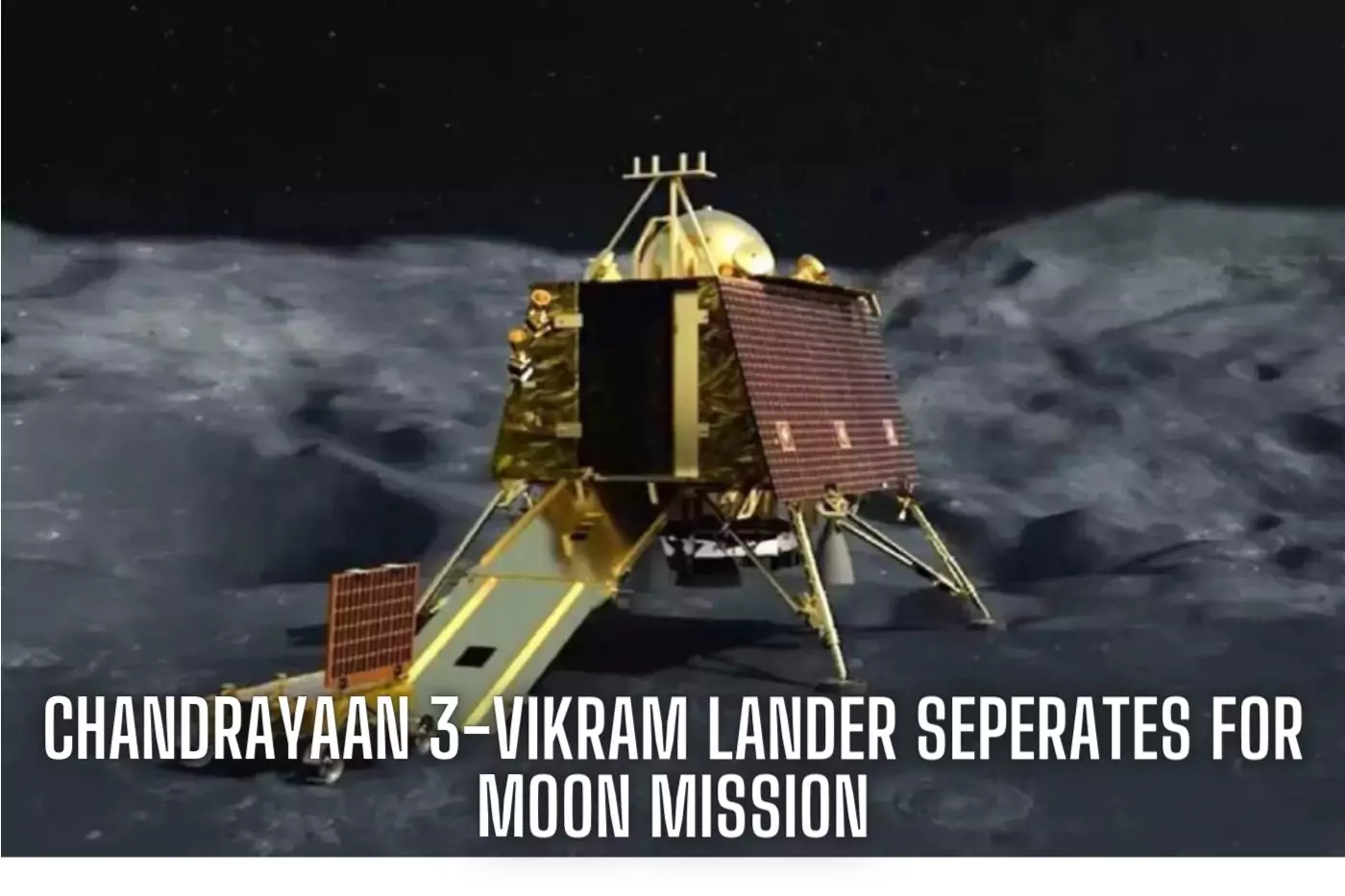
Chandrayaan-3, India’s third lunar mission, has reached an important phase as the Vikram lander has separated from the spacecraft’s propulsion module.
The Lander Module, which includes the Vikram lander and the Pragyan rover, is now ready to be moved to a lower orbit that will bring it closer to the Moon’s surface. The planned soft landing on the Moon’s south pole is set for August 23.
Countdown to Soft Landing Begins
The Lander Module is scheduled to descend to a slightly lower orbit after a planned deboosting maneuver on the next day around 4:00 PM, Indian Standard Time (IST), according to ISRO’s announcement.
Chandrayaan-3’s Path to Lunar Surface
Following the separation, the lander is expected to undergo a “deboost” process to slow it down and adjust its orbit. This will place the Perilune (closest point to the Moon) at 30 kilometers and the Apolune (farthest point from the Moon) at 100 kilometers. This particular orbital configuration is crucial for the attempted soft landing on the Moon’s south polar region.
Russia’s Luna-25 Challenge
Chandrayaan-3 faces competition from Russia’s Luna-25 mission, as both missions are aiming for lunar landings around the same time. The upcoming week will be decisive as the world waits to see which mission will achieve the historic feat of reaching the Moon’s south pole first.
While the Lander Module embarks on its descent to the Moon, the Propulsion Module will continue its journey in the current orbit for months or even years, as confirmed by the Indian Space Research Organisation (ISRO).
The Propulsion Module carries the SHAPE (Spectro-polarimetry of Habitable Planet Earth) payload, which is designed to study Earth’s atmosphere through spectroscopic analysis and measure polarization variations in Earth’s clouds. This data will contribute to identifying potential exoplanets suitable for habitability.
Chandrayaan-3 signifies India’s resilient spirit after past setbacks. The mission’s success is eagerly anticipated not only by ISRO and India’s leadership but also by its citizens. A successful soft landing could propel India to new heights in the field of space exploration.
The Indian Space Research Organisation had announced the separation of the landing module, containing Vikram and Pragyan, from the propulsion module, scheduled for August 17. This comes after a series of carefully executed maneuvers, including the fifth and final lunar orbit maneuver on August 16.
Further maneuvers are planned by ISRO to position Vikram in an elliptical orbit, facilitating the separation and setting the stage for the landing attempt. Meticulous deboost maneuvers are projected to establish the optimal orbit for the ultimate soft landing effort.
Chandrayaan-3’s Ambitious Goals
Chandrayaan-3, launched on July 14, is making strides in lunar exploration. The spacecraft has entered lunar orbit on August 5, and through a series of precisely planned maneuvers, it’s being positioned over the lunar poles.
Soft Landing Challenges and Rover’s Mission
The soft landing is a complex endeavor involving intricate maneuvers for braking. Once successfully landed, the six-wheeled Pragyan rover will conduct experiments on the lunar surface for the duration of one lunar day, equivalent to about 14 Earth days.
As Chandrayaan-3 continues its journey towards the Moon’s surface, India’s determination and scientific prowess are on full display. With each step meticulously planned and executed, the mission promises to redefine the boundaries of lunar exploration and scientific achievement. The world waits with bated breath for the historic soft landing attempt, eagerly anticipating the new frontiers of knowledge it will uncover.