


The Mumbai local train — officially the Mumbai Suburban Railway — is the city’s fastest and cheapest way to travel. Run by Indian Railways through Western Railway and Central Railway, it covers about 450 km with around 150 stations from Churchgate and CSMT to Dahanu Road, Kasara, Khopoli, Panvel and Uran, and carries an estimated 60–75 lakh passenger trips every day. That is why Mumbaikars call it the city’s lifeline. This guide explains every line, the types of trains (including AC locals), fares and passes, how to buy tickets on the RailOne app, rules and fines, and helpline numbers. To see every line and station on one page, open our Mumbai local train map.
Operational · Western, Central, Harbour, Trans-Harbour & Port lines
Network
About 450 km · 150 stations
Daily trips
About 60–75 lakh
Fare
From ₹5 (second class)
Tickets
Counter, ATVM, RailOne app
Last checked: October 2026 · Timings and fares can change — confirm on the RailOne app or at the station.
- Lines
- History
- Types of trains
- Fares & passes
- Tickets
- Metro links
- Rules & fines
- Helplines
- Upcoming projects
- FAQs
Mumbai local train lines at a glance
The suburban network is split between two zones of Indian Railways. Western Railway (WR) runs the Western line, and Central Railway (CR) runs the Central main line, the Harbour line, the Trans-Harbour line and the Port line to Uran. Each of the two main corridors is well over 100 km long. For the whole network on one page, see our Mumbai local train map. Each line section below has a tap-to-open route map: bigger filled dots mark major fast-train stops, and on a phone you can swipe the map sideways.
| Line | Route | Operator | Key points |
|---|---|---|---|
| Western line | Churchgate – Virar – Dahanu Road (124 km) | Western Railway | Fast and slow trains; 12- and 15-car rakes; AC locals |
| Central main line | CSMT – Kalyan – Kasara / Khopoli | Central Railway | Splits at Kalyan; fast, semi-fast and slow trains; AC locals |
| Harbour line | CSMT – Panvel; CSMT – Bandra – Goregaon | Central Railway | Branches at Wadala Road; AC locals to Panvel since Jan 2026 |
| Trans-Harbour line | Thane – Vashi / Nerul – Panvel | Central Railway | Links Thane with Navi Mumbai; AC locals |
| Port line | Nerul / Belapur – Kharkopar – Uran | Central Railway | Fully open to Uran since 12 January 2024 |
| Vasai Road – Diva – Panvel | Vasai Road – Bhiwandi Road – Diva – Panvel | Central & Western | Connector line with MEMU passenger trains |
Western line
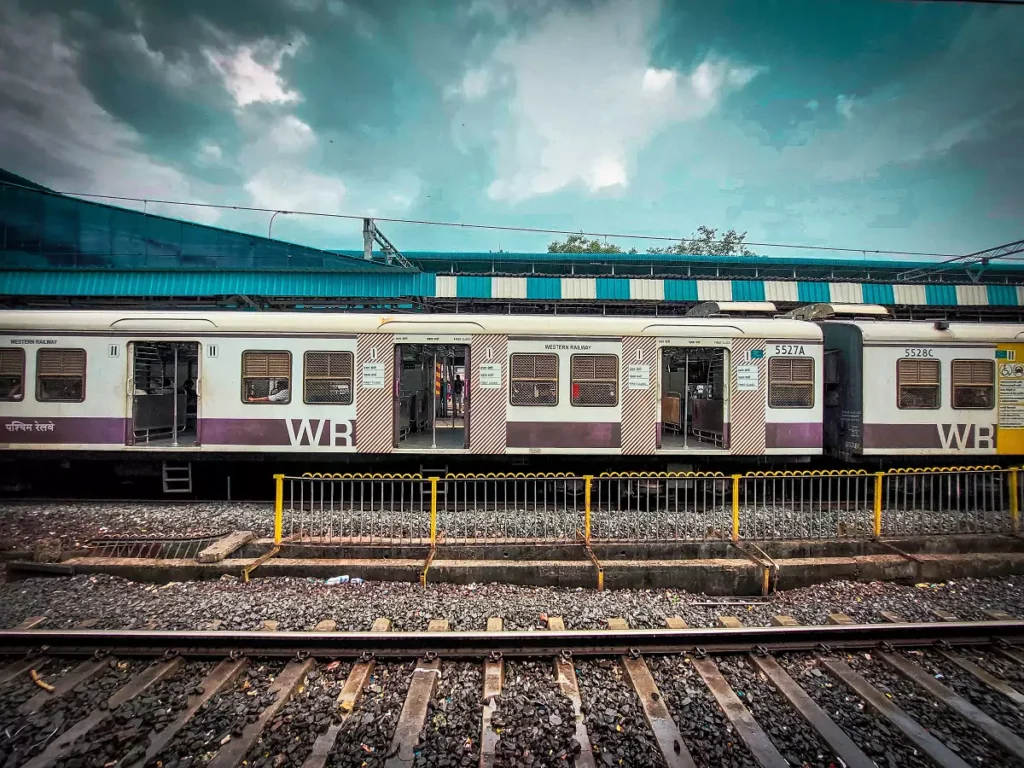
The Western line is operated by Western Railway and runs from Churchgate in south Mumbai through Mumbai Central, Dadar, Bandra, Andheri and Borivali to Virar and, beyond it, Dahanu Road — a 124 km stretch with about 37 stations. The line originally ended at Virar (about 60 km); suburban services were extended to Dahanu Road on 16 April 2013.
Western line trains are either fast or slow and run as 12-car or 15-car rakes. Fast trains stop only at major stations such as Mumbai Central, Dadar, Bandra, Andheri, Borivali, Bhayandar, Vasai Road and Virar, while slow trains stop at every station. Western Railway ran about 1,414 suburban services a day from February 2026, of which 133 were AC locals. Since 2026, 15-car EMUs also run between Virar and Dahanu Road.
Route map · Churchgate – Virar – Dahanu Road
Major fast-train stop Slow trains only Swipe to see all stations →
- Churchgate
- Marine Lines
- Charni Road
- Grant Road
- Mumbai Central
- Mahalaxmi
- Lower Parel
- Prabhadevi
- Dadar
- Matunga Road
- Mahim Jn
- Bandra
- Khar Road
- Santacruz
- Vile Parle
- Andheri
- Jogeshwari
- Ram Mandir
- Goregaon
- Malad
- Kandivali
- Borivali
- Dahisar
- Mira Road
- Bhayandar
- Naigaon
- Vasai Road
- Nalasopara
- Virar
Beyond Virar
- Virar
- Vaitarna
- Saphale
- Kelve Road
- Palghar
- Umroli
- Boisar
- Vangaon
- Dahanu Road
Central line
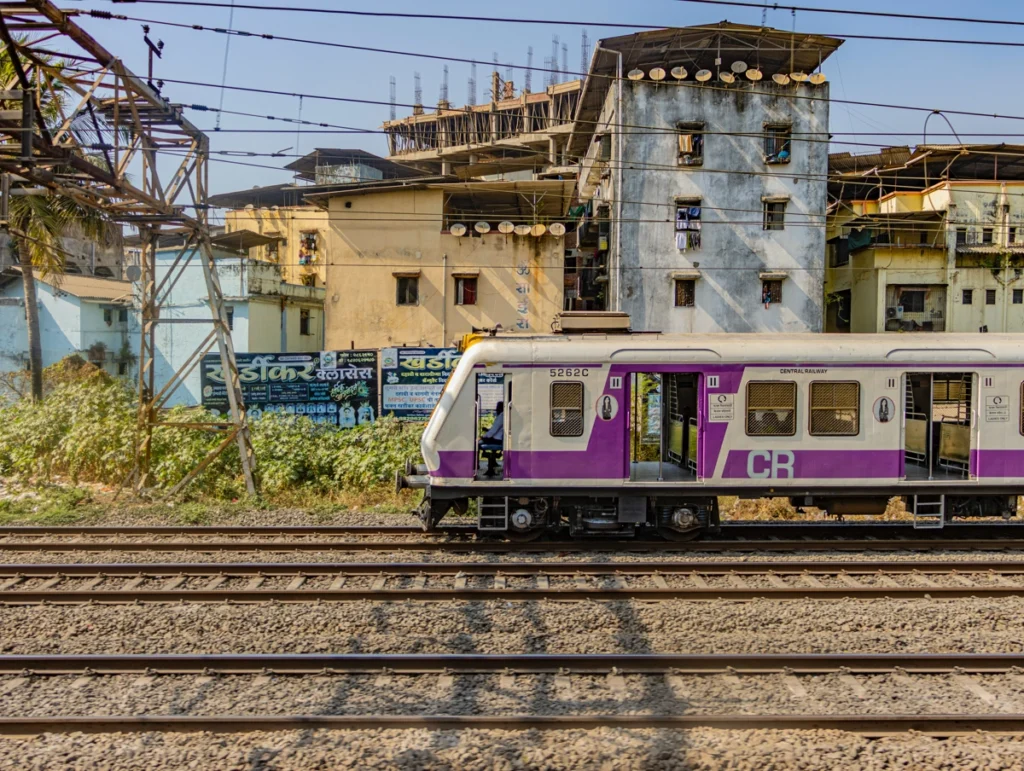
The Central main line is operated by Central Railway and starts at Chhatrapati Shivaji Maharaj Terminus (CSMT), formerly Victoria Terminus. It runs through Byculla, Dadar, Kurla, Ghatkopar, Thane and Dombivli to Kalyan, where it splits into two branches: north-east to Kasara and south-east to Khopoli via Karjat. Fast trains stop at major stations such as Byculla, Dadar, Kurla, Ghatkopar, Thane and Dombivli, while slow trains stop everywhere.
Central Railway has steadily added AC locals on the main line. AC services to Kalyan, Badlapur and Titwala were expanded in May 2025, and by May 2026 Central Railway ran 108 AC local services a day across its routes, with AC ridership up nearly 50% on the previous year.
Route map · CSMT – Kalyan – Kasara / Khopoli
Major fast-train stop Slow trains only Swipe to see all stations →
- CSMT
- Masjid
- Sandhurst Road
- Byculla
- Chinchpokli
- Currey Road
- Parel
- Dadar
- Matunga
- Sion
- Kurla
- Vidyavihar
- Ghatkopar
- Vikhroli
- Kanjurmarg
- Bhandup
- Nahur
- Mulund
- Thane
- Kalwa
- Mumbra
- Diva
- Kopar
- Dombivli
- Thakurli
- Kalyan
Kasara branch
- Kalyan
- Shahad
- Ambivli
- Titwala
- Khadavli
- Vasind
- Asangaon
- Atgaon
- Thansit
- Khardi
- Umbermali
- Kasara
Karjat / Khopoli branch
- Kalyan
- Vithalwadi
- Ulhasnagar
- Ambernath
- Badlapur
- Vangani
- Shelu
- Neral
- Bhivpuri Road
- Karjat
- Palasdhari
- Kelavli
- Dolavli
- Lowjee
- Khopoli
Harbour line
The Harbour line is also part of Central Railway. It shares the corridor with the Central line for a few stations from CSMT and then branches at Wadala Road into two routes. The first goes west through Kurla-side suburbs to Bandra, joins the Western line corridor and continues to Andheri and Goregaon. The second goes east through Kurla, Chembur, Mankhurd and Vashi into Navi Mumbai and on to Panvel.
Services therefore run on three main patterns: CSMT – Panvel, CSMT – Goregaon and Panvel – Andheri/Goregaon. All Harbour line trains are slow and stop at every station. AC local services on the CSMT – Panvel route began on 26 January 2026. A further extension of the Harbour line from Goregaon to Borivali is planned.
Route map · CSMT – Panvel / Goregaon
All trains stop at every station on this line Swipe to see all stations →
Common section
- CSMT
- Masjid
- Sandhurst Road
- Dockyard Road
- Reay Road
- Cotton Green
- Sewri
- Vadala Road
To Panvel
- Vadala Road
- GTB Nagar
- Chunabhatti
- Kurla
- Tilak Nagar
- Chembur
- Govandi
- Mankhurd
- Vashi
- Sanpada
- Juinagar
- Nerul
- Seawoods–Darave
- CBD Belapur
- Kharghar
- Mansarovar
- Khandeshwar
- Panvel
To Goregaon
- Vadala Road
- Kings Circle
- Mahim Jn
- Bandra
- Khar Road
- Santacruz
- Vile Parle
- Andheri
- Jogeshwari
- Ram Mandir
- Goregaon
Trans-Harbour line (Thane – Vashi – Panvel)
The Trans-Harbour line is another Central Railway route. It links Thane with Navi Mumbai through Airoli, Rabale, Ghansoli, Koparkhairane and Turbhe. One branch joins the Harbour line at Sanpada to reach Vashi, while the other joins at Nerul and runs parallel to the Harbour line to Panvel. Trains on this line stop at all stations, and AC locals also operate here.
An elevated link between Airoli and Kalwa is being built so that Trans-Harbour trains can run directly towards Kalwa and Kalyan without going through crowded Thane station. Its first phase, with the new Digha Gaon station, opened on 12 January 2024.
Route map · Thane – Vashi / Panvel
All trains stop at every station on this line Swipe to see all stations →
- Thane
- Digha Gaon
- Airoli
- Rabale
- Ghansoli
- Koparkhairane
- Turbhe
Vashi branch
- Turbhe
- Sanpada
- Vashi
Panvel branch (then Harbour line stations)
- Turbhe
- Juinagar
- Nerul
- Seawoods–Darave
- CBD Belapur
- Kharghar
- Mansarovar
- Khandeshwar
- Panvel
Port line (Nerul / Belapur – Uran)
The Port line, also called the Nerul – Uran line, is the newest suburban corridor of Central Railway. It links Navi Mumbai with Uran and the JNPA port area on two routes: Nerul – Uran and Belapur – Uran, meeting at Kharkopar. The first section to Kharkopar opened in 2018, and the final stretch from Kharkopar to Uran, with new stations including Gavan, Ranjanpada, Nhava Sheva, Dronagiri and Uran, was inaugurated on 12 January 2024. The line is now fully operational.
Route map · Nerul / Belapur – Uran
All trains stop at every station on this line Swipe to see all stations →
From Nerul
- Nerul
- Seawoods–Darave
- Bamandongri
- Kharkopar
From Belapur
- CBD Belapur
- Sagar Sangam
- Bamandongri
- Kharkopar
Kharkopar to Uran
- Kharkopar
- Gavan
- Ranjanpada
- Nhava Sheva
- Dronagiri
- Uran
Vasai Road – Diva – Panvel line
This line runs around the edge of the suburban network, linking the Western line at Vasai Road with the Central line at Diva and the Harbour line at Panvel via Bhiwandi Road and Taloja. It is mainly a freight and long-distance route, but MEMU passenger trains run on it, giving commuters from Vasai–Virar a way to reach Thane district and Navi Mumbai without going through the city.
Route map · Vasai Road – Diva – Panvel
All trains stop at every station on this line Swipe to see all stations →
- Vasai Road
- Juchandra
- Kaman Road
- Kharbao
- Bhiwandi Road
- Kopar
- Diva
- Dativali
- Nilaje
- Taloja Panchnand
- Navade Road
- Kalamboli
- Panvel
History of the Mumbai local train
The Mumbai suburban network grew out of the first passenger railway in India. On 16 April 1853, a train ran 34 km from Bori Bunder — today’s Chhatrapati Shivaji Maharaj Terminus — to Thane, operated by the Great Indian Peninsula Railway during British rule. It is often described as the oldest railway system in Asia.
On the western side, the Bombay, Baroda and Central India Railway began a suburban service between Virar and Bombay Backbay on 12 April 1867; the line was later extended to Churchgate. Electric trains (EMUs) arrived in the 1920s: the first ran between Victoria Terminus and Kurla on 3 February 1925, and the Western line followed in 1928. Over the next century the network expanded into Navi Mumbai, Thane district and Palghar, and the whole system moved to 25 kV AC power by 2016.
Types of trains
- Fast and slow trains: a train is either FAST (fewer stops) or SLOW (stops at all or most stations). Station indicators show F or S next to each departure.
- Fast-train stations: on route maps, stations served by fast trains are usually marked in red.
- Train length: most trains have 12 coaches; some run with 15. Fast services and 15-car trains run on the Western and Central main lines.
- AC locals: fully air-conditioned trains run on the Western line, the Central main line, the Trans-Harbour line and the CSMT – Panvel Harbour route. They run to their own timetable and need an AC ticket or pass.
- Classes: ordinary trains have second-class and first-class coaches, plus coaches reserved for women and for differently-abled passengers.
- Ladies specials: some services run only for women — see the women’s section below.
- Automatic doors: after the June 2025 Mumbra accident, the Railway Board ordered non-AC locals with automatic door closing. The first such 12-car rake reached Kurla car shed in April 2026 for trials, and 238 new AC train sets have been approved to gradually replace the older fleet.
Fares & passes
Mumbai local fares are distance-based and among the cheapest anywhere. The Indian Railways fare revision of July 2025 did not change suburban single fares or season tickets.
| Ticket | What it costs (approx.) |
|---|---|
| Second class single | From ₹5 (minimum); about ₹10–₹20 for most city trips; about ₹25–₹35 Churchgate – Virar |
| First class single | Several times the second-class fare for the same distance |
| AC local single | Higher than first class; AC fares were cut by about 50% in May 2022 |
| Return ticket | Valid for the return journey on the same day |
| Season ticket (pass) | Monthly, quarterly, half-yearly or yearly for a fixed route — the cheapest option for daily travel |
Because exact fares depend on the stations and class, check the fare in the RailOne app or at the ticket window before you travel.
How to buy Mumbai local train tickets
You can buy a ticket for a single journey (one way) or a return journey, or a season ticket for regular travel. Tickets can be bought at the station booking office, from an Automatic Ticket Vending Machine (ATVM), or on the RailOne mobile app. Always buy your ticket before boarding — ticket checkers board trains and check at station exits.
Ticket booking office
Every suburban station has at least one or two booking windows where you can buy single, return and season tickets in any class. Many stations also have a separate window for women and a counter for differently-abled passengers.
ATVM (Automatic Ticket Vending Machine)
ATVMs are installed at suburban stations, usually near the main entrance. You can buy first- and second-class single and return tickets, renew season tickets and buy platform tickets for adults and children. Newer machines accept UPI, cards and QR-code payments, as well as Indian Railways smart cards.
A smart card can be bought and recharged at the booking office of a suburban station, and gives an extra 3% value on each recharge. The details below are those historically published by the railways — confirm current charges at the booking office:
- Smart card cost: ₹70 (₹50 refundable deposit + ₹20 recharge value)
- Benefit: 3% extra value on every recharge
- Tickets issued: first and second class, single, return and platform tickets, and season ticket renewals for adults and children
- Minimum recharge: ₹20; maximum recharge: ₹9,500
- Cancellation charge: ₹30; validity: one year from the last recharge
RailOne app (replaces UTS)
The UTS app, long used for paperless local tickets, was phased out and shut down on 1 March 2026. Unreserved tickets and season passes are now booked on RailOne, the Indian Railways app launched in July 2025 for Android and iOS.
- Install RailOne and log in with your existing UTS or IRCTC details, or register with your mobile number or email.
- Your R-Wallet balance and any valid season ticket move across automatically when you log in with the same registered mobile number.
- Choose the unreserved/suburban ticket option, select the “from” and “to” stations, the class and the ticket type; the app shows the fare.
- Pay from the R-Wallet, UPI or a card. Digital payments get a 3% discount.
- Your ticket appears as a QR code in the app — show it to the ticket checker. No printout is needed.
- For single-journey tickets you need to be within about 5 km of the starting station when booking; season tickets can be booked from anywhere.
Season ticket (monthly pass)
Daily commuters can buy a season ticket for a fixed route — monthly, quarterly, half-yearly or yearly — at the booking office, through an ATVM renewal, or in the RailOne app. Passes issued on the UTS app remain valid until they expire, but renewals must now be done through RailOne.
Metro connections
Many local train stations now connect with the Mumbai Metro, making it easier to reach areas away from the railway lines. See the full Mumbai Metro map for all lines.
| Local train station | Nearby metro | Useful for |
|---|---|---|
| Andheri (WR) | Line 1 Andheri | Ghatkopar, Saki Naka, Versova; change to Line 3 at Marol Naka |
| Ghatkopar (CR) | Line 1 Ghatkopar | Andheri and the Western suburbs |
| Churchgate, Grant Road, Mumbai Central (WR) | Line 3 stations | Cuffe Parade, Worli, BKC, airport |
| CSMT, Dadar | Line 3 stations | Worli, Siddhivinayak, BKC, airport |
| Santacruz (WR) | Line 3 Santacruz | BKC and the airport terminals |
| Dahisar (WR) | Line 2A / Line 7 Dahisar (East) | Mira Road via Line 9, Andheri (E) and Andheri (W) |
| CBD Belapur, Kharghar (Harbour) | Navi Mumbai Metro | Kharghar, Taloja and Pendhar |
Facilities for women
Western Railway also operates ladies special trains intended only for women, for extra safety and comfort during busy hours. Every ordinary local train has coaches reserved for women, and at many suburban stations there is a separate ticket window for women. Railway Protection Force and Government Railway Police staff patrol trains and stations, and women can call the helplines listed below at any time.
Facilities for differently-abled passengers
Divyangjan (differently-abled) passengers and cancer patients have reserved compartments: the fourth and seventh coaches from the Churchgate end in 12-car trains, and the fourth, seventh and tenth coaches in 15-car trains. Pregnant women are also allowed in these compartments. All stations have Divyang-friendly ticket windows and enquiry counters.
Luggage allowed on Mumbai local trains
Passengers on first-class and second-class tickets are allowed a limited free luggage allowance for personal belongings. The general rules are:
- Season tickets and single/return tickets cannot be used to carry luggage beyond the free allowance on EMU trains.
- Passengers who need help carrying a tricycle (used by differently-abled passengers) are not charged for it.
- Unbooked or partly booked luggage above the free allowance can attract a fine.
- Passengers carrying more luggage than their free allowance will be charged.
- Bulky, offensive, inflammable, explosive or otherwise dangerous articles are not allowed on board.
Offences & penalties
Ticket checking is strict, and offences are punishable under the Railways Act, 1989. The main offences and penalties are:
| Offence | Section (Railways Act) | Penalty |
|---|---|---|
| Travelling without a proper ticket or pass | 138 | Ordinary single fare for the distance travelled plus an excess charge of ₹250 or the fare, whichever is more |
| Travelling fraudulently | 137 | Up to 6 months in jail, a fine of ₹1,000, or both |
| Pulling the alarm chain without reason | 141 | Up to 12 months in jail, a fine of ₹1,000, or both |
| Travelling in a coach reserved for disabled passengers | 155(a) | Up to 3 months in jail, a fine of ₹500, or both |
| Travelling on the roof | 156 | Up to 3 months in jail, a fine of ₹500, or both |
| Trespassing | 147 | Up to 6 months in jail, a fine of ₹1,000, or both |
| Nuisance and littering | 145(b) | ₹100 for a first offence; ₹250 and up to one month in jail for repeat offences |
| Pasting bills | 166(b) | Up to 6 months in jail, a fine of ₹500, or both |
| Touting | 143 | Up to 3 years in jail, a fine of ₹10,000, or both |
| Unauthorised hawking | 144 | Up to one year in jail, a fine of ₹1,000–₹2,000, or both |
Important helpline numbers
| Helpline | Number |
|---|---|
| Integrated railway helpline (enquiries, security, complaints) | 139 |
| Railway Protection Force (RPF) security | 182 |
| Government Railway Police (GRP) | 1512 |
| All emergencies (police, fire, ambulance) | 112 |
| Mumbai Police women’s helpline | 103 |
| National women’s helpline | 1091 |
In an emergency on a train, alert the guard or motorman at the next station, or call 139 or 112. Complaints can also be filed through Rail Madad in the RailOne app.
Upcoming projects
Several projects under the Mumbai Urban Transport Project (MUTP) will add lines and trains over the next few years:
- Panvel – Karjat corridor: a new suburban line, close to completion with a target of December 2026.
- Airoli – Kalwa elevated link: phase 1 (Digha Gaon) is open; the rest depends on land acquisition.
- Borivali – Virar 5th and 6th lines: about 30% complete, targeted for 2029.
- Virar – Dahanu Road quadrupling: about 64% complete, targeted for 2028.
- Kalyan – Badlapur 3rd and 4th lines: about 52% complete, targeted for 2028.
- CSMT – Kurla 5th and 6th lines: under way in phases, first to Parel.
- Harbour line to Borivali: extension from Goregaon to Borivali planned.
- New trains: 238 new AC train sets approved, plus non-AC locals with automatic doors.
Travel tips
- Avoid the peak hours (roughly 8–11 AM towards south Mumbai and 5–9 PM back to the suburbs) if you can — trains are extremely crowded.
- Check the indicator: F means fast, S means slow, and the number shows whether the train has 12 or 15 coaches.
- Stand near the door only if you are getting off at the next stop; move inside otherwise.
- Never travel on the footboard, the roof, or between coaches, and never cross the tracks — use the foot-over-bridges.
- Combine the local train with the metro for faster journeys across the suburbs — for example Andheri to Ghatkopar on Line 1.
Frequently asked questions
What is the minimum fare on a Mumbai local train?
The minimum second-class single-journey fare is ₹5. Fares rise with distance; a full trip from Churchgate to Virar costs about ₹25–₹35 in second class. First-class and AC tickets cost several times more. The July 2025 Indian Railways fare revision did not change suburban fares or season tickets.
What are Mumbai local train timings?
Services run from the early morning, around 4 AM, until after midnight, depending on the line and station. Trains run every few minutes at peak hours on the main corridors. Check the RailOne app or station displays for exact times.
How do I book Mumbai local train tickets online?
Use the RailOne app from Indian Railways. It replaced the UTS app, which shut down on 1 March 2026. You can buy single, return and season tickets, show a QR code to the ticket checker, and get a 3% discount on digital payment. For single journeys you must be within about 5 km of your starting station when booking.
How many lines does the Mumbai local train have?
The main suburban corridors are the Western line, the Central main line, the Harbour line, the Trans-Harbour line and the Port line (Nerul/Belapur – Uran). The Vasai Road – Diva – Panvel line links them and carries MEMU passenger trains.
Is the Nerul – Uran line fully open?
Yes. The final stretch from Kharkopar to Uran was inaugurated on 12 January 2024, so trains now run all the way from Nerul and Belapur to Uran.
Do Mumbai local trains have AC coaches?
Yes. Fully air-conditioned locals run on the Western line, the Central main line, the Trans-Harbour line and, since January 2026, the CSMT – Panvel Harbour route. Western Railway ran 133 AC services a day from February 2026, and Central Railway 108 a day from May 2026.
Which local train stations connect with the Mumbai Metro?
Andheri and Ghatkopar connect with metro Line 1; Churchgate, CSMT, Grant Road, Mumbai Central, Dadar and Santacruz are close to metro Line 3; Dahisar is near Line 2A and Line 7; and CBD Belapur and Kharghar connect with Navi Mumbai Metro.
How many people travel by Mumbai local train every day?
Roughly 60 to 75 lakh passenger trips are made every day, which is why the network is called the lifeline of Mumbai. The Western line alone carried about 25.6 crore passengers between April and June 2026.
What is the fine for travelling without a ticket in a Mumbai local?
Under Section 138 of the Railways Act, a ticketless passenger pays the ordinary single fare plus an excess charge of ₹250 or the fare, whichever is more.
Sources: Wikipedia – Mumbai Suburban Railway · Free Press Journal – UTS to RailOne (Feb 2026) · Free Press Journal – WR AC services (Feb 2026) · Free Press Journal – CR AC ridership (May 2026) · MUTP status report (Aug 2026) · Daijiworld – automatic-door local (Apr 2026)